
Aljazeera : Influential cleric issues fatwa against terrorism

By John L. Esposito
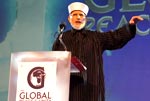
An influential Pakistani cleric issued a 600-page fatwa on March 2, described as an "absolute" condemnation of terrorism without "any excuses or pretexts." Muhammad Tahir ul-Qadri declared that terrorists and suicide bombers were unbelievers and that "terrorism is terrorism, violence is violence and it has no place in Islamic teaching and no justification can be provided for it, or any kind of excuses or ifs or buts."
While domestic politics in Muslim countries, the presence of foreign troops and the impact of Western foreign policies remain primary drivers in radicalization, a major, comprehensive fatwa like this -- along with less-sweeping fatwas issued by other religious authorities -- does constitute a major challenge to the legitimacy of al-Qaeda and other terrorist groups.
Qadri's fatwa is an exhaustive, systematic theological and legal study of the Islamic tradition's teachings on the use of force and armed resistance to support an absolute condemnation of any form of terrorism for any cause. Its significance will be felt in Pakistan, where Qadri over several decades has become a prominent scholar and religious leader as well as a religious media star. It will also have an impact in the West young Muslims in Britain, Scandinavia and Canada, many of whom are of Pakistani backgrounds.
Qadri is a Barelvi Muslim scholar (Barelvi and Deobandis, who claim to follow a more pristine version of Islam, are the two major Sunni Muslim groups or schools of thought in the Indian subcontinent). The Barelvi are estimated to be the largest Muslim group in Pakistan, India and Great Britain. Qadri, noted for his liberal and tolerant views, promotes greater unity among Muslims and inter and intra faith dialogue, reaching out to other theological schools like the Deobandi and to Shiah Muslims and Pakistani Christians. He emphasizes religious, social, and cultural teachings of Islam.
Trained both in traditional madrasas and at Punjab University where in 1972 he earned an MA and PhD in Islamic Studies, Qadri appeals to a broad audience of traditionalists and those that appreciate his integration of traditional Islamic sciences with modern disciplines. Qadri's career took off in the mid-1980s with a popular national television program Fahm-e-Quran (Understanding the Qur'an), speaking in down to earth popular idioms and using analogies from everyday life.
Qadri is among a handful of prominent popular preachers in Pakistan (as elsewhere in the Muslim world) whose primary medium for propagating their messages is the electronic technology (cassettes, videos, CDs, DVDs, and television channels). Qadri's media career has been unprecedented in the modern religious history of Pakistan. Founder of Minhaj-ul-Quran International, based in Lahore, an Islamic movement with centers in 90 countries, its publication house carries thousands of Qadri's CDs and DVDs Urdu, Punjabi, Arabic and English, delivered in Pakistan, India, the Middle East, Europe, the United States, and Canada.
Qadri already has an established track record in his denunciation of terrorism in the name of Islam. One of the few religious leaders in Pakistan who unequivocally condemned the September 11 terrorist attacks, Qadri has challenged the Islamic legitimacy of those who approved the use of violence for religious or political ends. He has condemned al-Qaeda and the Taliban, denouncing al-Qaeda a "lethal threat to Islam and Muslims," whose actions are antithetical to Islam's message of peace.
In a December 5, 2009 press conference, drawing extensively on Islamic texts, Qadri declared: "Islam does not permit, under any circumstances, the massacre of innocent citizens, terrorist explosions and suicide bombings" which according to Islamic law are unacceptable violations of human rights and constitute kufr, (unbelief). At the same time, Qadri has also been a strong critic of the U.S. invasion of Afghanistan and Iraq.
-- John L. Esposito is University Professor and Founding Director of the Centre for Muslim-Christian Understanding. He is co-author of Who Speaks for Islam? What a Billion Muslims Really Think, and author of the newly released book The Future of Islam (2010).
Source : http://www.aljazeera.com/news/articles/39/Influential-cleric-issues-fatwa-against-terrorism.html







Comments