
Express: Muslim cleric holds ‘anti-terror camps’

Posted by admin on Aug 11th, 2010 // No Comment
Coventry, England (CNN.COM) – Tired of Islamic terror camps grabbing headlines, a Pakistani Muslim cleric is fighting back by holding his own “anti-terror camp.”
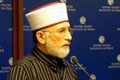
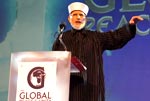
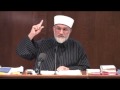
Islamic cleric Shaykh Muhammad Tahir ul-Qadri is the man behind “Al-Hidayah,” an Islamic retreat at the University of Warwick, in the UK.
He preaches peace and love and tolerance — but not for radical extremists.
“Al Hidayah” means guidance and the three-day retreat is billed as a summer camp for Islamic learning, especially for a younger generation. This year the focus is exclusively on fighting extremism.
Ul-Qadri runs a multimedia empire that showcases his lectures in Pakistan, but in Britain he is promoting his recent fatwa on terrorism.
He issued the fatwa in March 2010 — a 600-page religious edict that denounces terror attacks. It condemns suicide attackers to hell and disowns them from Islam.
Available online in English, Arabic and Urdu, the fatwa meticulously sources the Koran and other classical Islamic texts.
It’s viewed by some as arguably the most comprehensive theological rejection of terrorism to date. Something a silent Muslim majority has long demanded, Ul-Qadri told CNN.
“The reality is that [Muslims] were waiting for a long, long time to get this kind of voice,” he said.
“Their hearts had become desert and their spirits and their souls were thirsty. And unfortunately, the peaceful people are always silent. They don’t create news,” Ul-Qadri added.
Al-Hidayah has been running for six years in the UK. About 1,500 participants came this year, many of them teenagers from across Europe and North America.
One participant, Qazi, is from Chicago. He says the events of 9/11 left many young American Muslims in a state of confusion.
“Definitely people were getting confused, and were worrying about their identity,” Qazi told CNN. “What does it mean to be a Muslim? Does it mean to do something like this?”
When Qazi heard about the fatwa on terrorism, he immediately booked a place at Al-Hidayah.
“It’s really an amazing feeling to know it’s official and something’s happening. I just wish it could have happened a whole lot earlier,” he said.
Ul-Qadri also loudly tackles women’s rights among other things, saying women should be allowed to pray with men in mosques with no separation — a point he makes with humor.
“They don’t feel need of any curtain when they send [women] to market for grocery and shopping,” he tells his audience at Al-Hidayah.
“No curtain there. No curtain at social gatherings. When they come to pray, a 10-foot high wall curtain is between them,” he said.
It’s a refreshing take on Islam for Dutch teenager Yasmin. “It’s a place of being home, returning back home,” she told CNN. “So if I see all those people, boys, girls, in Islamic clothes, it makes me happy, and in Holland, I miss that feeling.
“You really missed something last year because one of the lectures was about women’s rights. I cried for, like, two hours,” Yasmin said.
Next year, Al Hidayah will be in London and they are expecting more than 5,000 participants. Evidence, perhaps, that ul-Qadri’s message is spreading.
Source : http://www.express.ae/muslim-cleric-holds-anti-terror-camps.html







Comments