
Women Training Itikaf 2009: Sixth Day
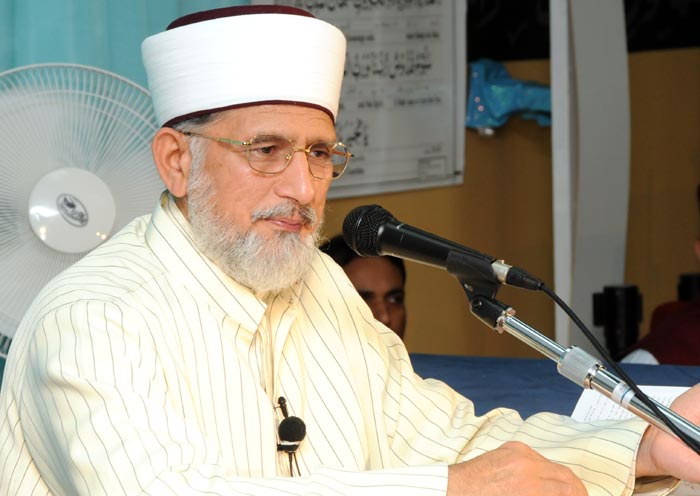
Lecture by Shaykh-ul-Islam (Part 01)
Lecture by Shaykh-ul-Islam (Part 02)
Dua by Shaykh-ul-Islam
The sixth day of Itikaf started as usual with Salat-o-Salam by the Sunna and Salat Committee, making the ‘mu’takifat’ rise to offer their Tahajjud prayer. This was followed by serving the Sahri food to the participants in their rooms. Announcements continued on the teachings of Sunna. By now the ‘mu’takifat’ have achieved a standard and do not forget doing things conscious of the Prophetic Sunna; al-Hamdulillah. The participants then recited the individual wazaif permitted by Shaykh-ul-Islam. After Fajr prayer Mehfil-e-Dhikr-o-Na’at was held, Ashraq prayer was performed and later congregational Salat-ut-Tasbih was offered.
Shaykh-ul-Islam delivered his speech on Tawba today. He started his discourse with the analysis of our response to the wrongs done to us. You wrong the wrongdoer; that is justice. But you respond nicely to the wrongdoer; that is generosity. One should turn away from justice and turn towards generosity. Justice is the lower level of taqwa (righteousness and Godwariness) while generosity is its higher standard.
According to an agreed upon hadith the Holy Prophet will intercede with Allah on the Day of Resurrection and prostrate himself before Him. A group of people will be such as will be admitted to Paradise after undergoing chastisement; they will be the unjust people. Another group of people will be the ones who will enter Paradise after scrutiny. These are the believers. Those coming from Hell will be called the people of Hell (Jahannami). The Companions asked how they will be treated. The Prophet said: The suffering a believer undergoes in the world like diseases, tribulations, debts and robberies occur in lieu of the torment in the hereafter. And there will not be any believer that he observes patience on being afflicted but Allah does not exalt his grades. The third group will take the Last Day as a happy day. They will be as many as seventy thousand people; they will enter Paradise without any scrutiny. They will be standing in a queue. They will not enter Paradise until the last of them is admitted to Paradise. According to another report the Holy Prophet said: They will be such as each of them will take another 70 thousand along with them into Paradise.
Shaykh-ul-islam quoted Ghawth-ul-Azam (may Allah be well pleased with him) saying: Be extinct to the Creation in your relation with Allah and be extinct to your self in your relation with the Creation.
Tawba implies turning towards Allah. The one turning towards things other than Allah will be distant from Tawba. The right path is the share only of those who are saints, the pious servants of Allah and have attained to His nearness. In the beginning repentance is an idea that occurs to one. This occurrence is basic to the act of repenting. The one whom it occurs repents. What comes in its way is negligence. It keeps one from doing it.
He said that one has to wake up and fight back negligence. The one who rises to it is he who rises; it cannot be the one who sleeps. To wake up and rise, one needs to see Allah’s favours. If one sees His greatness and smallness of his own self his sins will be seen as magnified. These things come to you from the company of the pious and saints.
Tawba has three stages: remorse, giving up the sin and resolve never to commit the sin again. Allah feels pleased with one’s repentance more than one’s prostration. Allah loves the repentant. According to hadith the one who repents is like the one who does not commit sin. He also numerated and explained kinds of Tawba: Sharī Twba or repenting the sin; Tawba in Tarīqa or repenting following lusts; Tawba al-Khitā or repenting follies for reward; Tawba ar-Rijā or repenting for Paradise; Tawba al-Khauf or repenting due to fear of Allah and Tawba to escape Hell.
After Zuhr prayer during the rest time of the ‘mu’takifat’ Tanzimi and Tarbiyyati meetings were arranged for the Tanzimat attending the Itikaf. All of them participated. These meetings have been a regular feature of this training Itikaf and has proved to be of special benefit towards better understanding, coordination and teamwork among the Tanzimat and the Central MWL Team. President Women League Mohtarma Fatima Mash`hadi and Nazima Women League Mohtarma Sumaira Rafaqat Advocate, and Mohtarma Sajida Sadiq Naib Nazima WL conducted these meetings. They welcomed the suggestions and opinions of the participating Tanzimat on implementation of the working plan, methods to conduct the related activities particularly raising the membership and wabastgi in their respective Tehsilat, fields and areas. They held healthy discussions to improve upon the performance of the Tanzimat in view of the difficulties peculiar to each Tanzim.
Asr prayer was offered followed by Mehfil-e-Dhik-o-Na’at. The sisters presented some beautiful and moving nasheeds and warmed the hearts of the audience.
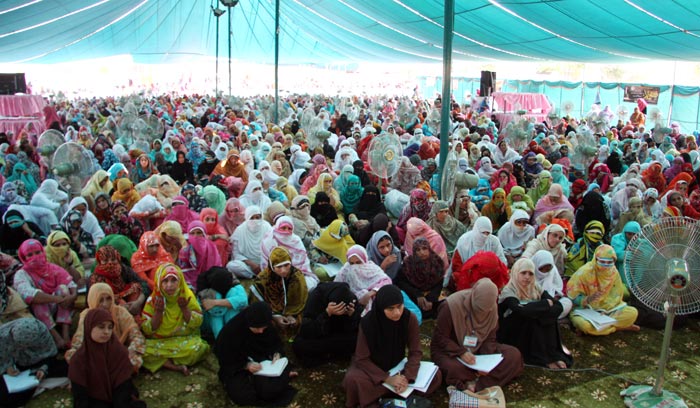
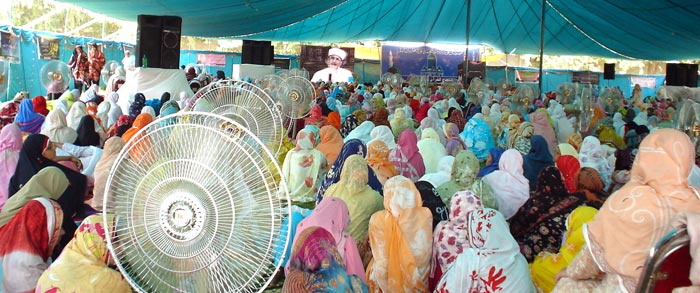
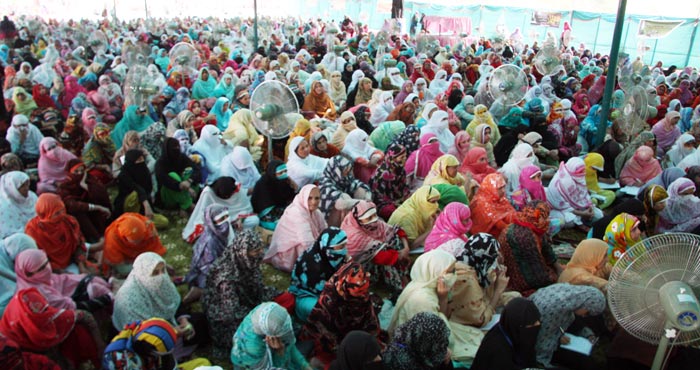
The 27th Ramadan night was now to fall. That is always a special event in the Itikaf. An International spiritual gathering is organized; special Dhikr-o-Na’at programme is held and congregational Salat-ut-Tasbih is performed. Then Shaykh-ul-Islam Dr Muhammad Tahir-ul-Qadri delivers his speech followed by special Dua. So, special arrangements are always made for this huge activity. This time also preparation started quite early. The gathering of the ‘mu’takifat’ was divided into two areas one for the Masnun ‘mu’takifat’ and the other for the voluntary ‘mu’takifat’. A large number of ladies assembled in the assembly area after Aftaar and evening prayer. By Isha time both the areas were jam-packed. As there was not much room left in the internal assembly area both the areas were then amalgamated into one to accommodate and facilitate everyone to participate and offer Salat-ut-Tasbih.
The 27th Ramadan Night
A brief Na’at session was held after Salat-ut-Tasbih followed by speech by Shaykh-ul-Islam on the subject of Ukhuwa and Suhbah (Brotherhood and Companionship). He spoke on the significance of Ukhuwa and Suhbah, highlighted its conditions, rights and proprieties. He compared our practices with that of the pious predecessors and pointed out where we need to improve upon and how.
Dīn is nothing but adab. Adab implies respect, regard, veneration, polite manners, nice conduct, submissiveness, love and devotion, all in one. Ukhuwa and Suhbah are the commands and basic values of Dīn. Allah has revealed in the Quran: ‘Save yourself and your family members from fire.’ All leading authorities of exegeses agree that it means “addibūhum”, teach them adab of Dīn and adab of saving oneself from fire i.e. how to implement Dīn and how to save from fire. 'How' means the way and the methods involved to accomplish it. This leads us to fulfilling the rights of Allah, His Messenger, His favourite servants, the Prophet’s family members, the believers, relatives, friends and companions. This comes to attend to all the rights and observe all good manners one has to do in life. One who does it is believed to have strong faith in his heart.
These manners encompass our entire life. Islam teaches us to observe manners even while slaughtering the animals. For example the knife should be sharp to cause the animal the least trouble while being slaughtered. Also it should not see any other animal being slaughtered. So what is the adab Umma has to observe? It is observing obedience and following the Sunna. Adab for the Holy Prophet is following him; adab for people is nice and polite behaviour and safeguard of human dignity.
What manners a Muslim is to observe while meeting others? That is to be the first one to invoke peace on others. When one approaches a meeting the people sitting there should provide him room and accommodate him and should call him by pleasant name.
All manners and acts emanate from good intention. That is why one should join good company for the sake of Allah; it should be the company of the pious. It is because good company helps us safeguarding our faith and Dīn. Shaykh-ul-Islam here observed that we and our generations are exposed to many dangers. There are temptations to get inclined to evil. Faith, righteousness, piety, moral values and human dignity are very difficult to protect. It is a boon that there are platforms like Minhaj-ul-Quran that you can join for learning moral and spiritual values. If you do not join any such platform there is no guarantee of the safety of your faith and Dīn. Here you get Ukhuwa and Suhbah of the pious. You get good books to read and addresses made on a wide variety of subjects to hear through cassettes, CDs and DVDs. You can enjoy their company even while driving, in leisure time, relaxing in bed or attending friends informally. These are some kinds of Suhba. Then there are sessions of Gosha-e-Durood, Khatmus-Salat, Drus-e-Quran, Itikaf and many other gatherings where you come to join pious company, to remember Allah and His Messenger, listen to the Quran and hadith. All that helps you to revive your faith and Dīn. He said, 'We have no claim that we are very good. We are humble servants of Allah. There may be very many people better than us. But the point I am trying to make is that it is not possible to safeguard faith and Dīn being all alone, having no suhbah and no company to sit in where one may feel inspired towards doing good.'
Shaykh-ul-Islam substantiated his talk with the verses of the Holy Quran, the Prophetic traditions, the sayings and teachings of great spiritual masters and the pious servants of Allah. The programme ended with Dua by Shaykh-ul-Islam Dr Muhammad Tahir-ul-Qadri madda zilluhul aali.
Report prepared by: Maryam Hafeez Naib Nazima Tarbiyyat MWL
(Part 01)
(Part 02)







Comments