
Special Joint Programme of Laylatul Qadr 2010 & Monthly Spiritual Gathering
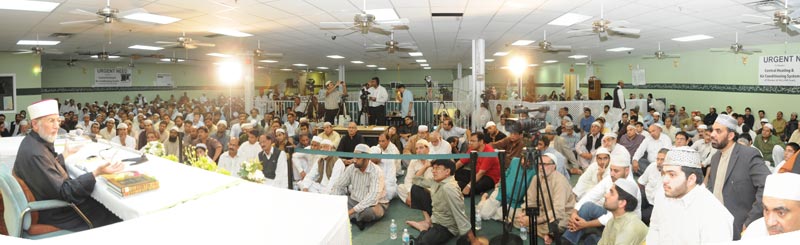
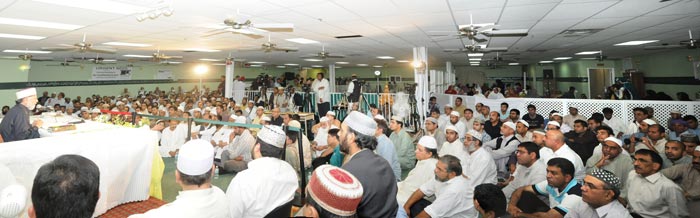
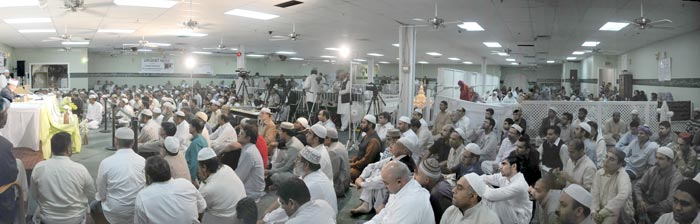
Minhaj-ul-Quran International organized a joint programme of ‘Laylatul Qadr’ and monthly spiritual gathering in its central secretariat on September 6, 2010. In view of a large scale of devastation caused by floods and consequent displacement of over 20 million people, Shaykh-ul-Islam Dr Muhammad Tahir-ul-Qadri declared to cancel the Itikaf city 2010 and advised all the intending participants of the Itikaf to take part in the relief activities of the Minhaj Welfare Foundation for twelve days including the Eid day. He also declared that Rs. 30 million, which were to be incurred on organizing Itikaf, would be spent on the relief of the flood victims. Thus annual program of ‘Shab-e-Qadr’, which is held in Township Lahore and attended by hundreds of thousands of people from across Pakistan, was not held. MQI only organized a small programme of ‘Laylatul Qadr’ whose proceedings were telecast live from 1 a.m. to 3:00 a.m. by ARY News channel.
Seated on the stage were acting Secretary General Sheikh Zahid Fayyaz, Raja Jamil Ajmal, Jawad Hamid, and Sahibzada Zaheer Ahmad Naqshbandi. The formal proceedings of the program got underway with the recitation from the Holy Quran by Qari Allah Baksh Naqashbandi followed by Naat, which was recited by Qari Anser Ali Qadri.
The chief highlight of the programme was a live speech of Shaykh-ul-Islam Dr Muhammad Tahir-ul-Qadri through video conferencing from Canada, which was shown live around the world by ARY News channel. Shaykh-ul-Islam chose the subject of ‘Ibadat’ (worship) and recited the following verses from the Glorious Quran:
“I created Jinn and human beings solely to adopt my servitude” (51:56)
“Indeed the (angels) who are close in the presence of your Lord (never) turn away from His worship in arrogance, and glorify Him (all the time) and remain prostrate before Him.” (7:206)
“And indeed we sent a messenger in every people:, (‘ O people,) worship Allah.” (16:36)
Starting his keynote speech, Shaykh-ul-Islam Dr Muhammad Tahir-ul-Qadri said that the way Allah Almighty has bracketed His elevated status with Divinity, that status can never get separated from Him. Whether one admits it or not, He is the Master. It makes no difference to His attribute of Divinity even if one keeps on worshipping the thousands of idols. He is the One Who is to be worshipped and it is His Right only. In the same way, man has been endowed with the attribute of a worshipper. Man would continue to be a subordinate servant even if he tries his level best to get maximum powers and claims to be god. Man can never become absolute Master.
Shaykh-ul-Islam said that there are three stages of servitude namely (1) Worship, (2) Abdiayat, (3) Aboodiat. He said that Allah Almighty described the purpose of human creation in the Holy Quran that “I created men and Jinn so that they adopt My servitude” (51:56). Explaining the concept of worship, Shaykh-ul-Islam said that it was not merely confined to performance of rituals such as prayers, fast, Zakat and Hajj etc. They are no doubt different forms of worship but they are not the whole in totality. He said that worship represents a very wide and comprehensive concept, a concept which connects man to his Lord and strengthens his relationship with Him.
Shaykh-ul-Islam Dr Muhammad Tahir-ul-Qadri said that every act, which is instrumental in winning the pleasure of Allah is part of worship and giving up every such act, which results in earning annoyance of Allah Almighty is likewise part of the worship paradigm irrespective of whether the nature of such act is familial, social, political, religious or economic. So much so that every gesture towards humankind based on goodness enjoys the status of worship in the Islamic teachings.
Dr Muhammad Tahir-ul-Qadri said that when someone falls in love with the other, he is always desirous of winning the pleasure of his beloved. Worship is a love between man and his Lord by which man avoids annoyance of his Beloved (Allah). This means that every such action due to which Allah loves man is worship. Expressing sympathy with the poor, mitigating the sufferings of the flood affectees, planting a tree for the service of humanity and removing a brick or a pebble from the road is also worship. He said that in this way all actions in respect of humanity and spiritualism fall in the ambit of worship. This is how the concept of worship becomes comprehensive and multi-dimensional, which needs to be popularized in the society today.
Shaykh-ul-Islam said that Pakistan is confronted with different kinds of torments and tragedies today. On the one hand, we face the prospect of starvation due to drought and on the other; our lands and people get submerged in the heaviest floods. No single day passes when we are not faced with distressing news. Such incidents as lynching of two brothers in Sialkot show how degraded we have become. If we do introspection with a view to knowing as to why things have gone so wrong with us, we would conclude that it is our punishment due to our reneging on the promise made with Allah at the time of establishment of Pakistan. He said that we need to rethink our conduct as a nation whether we are fulfilling the requirements of our servitude towards Allah Almighty. Referring to a Quranic verse wherein Allah Almighty advised His subjects not to fear people of the world, for he who fears Allah places his total dependence and reliance on Him and is afraid of none. Our state of affairs is such that we think since we have read ‘Kalma’, therefore, we have become faithful. Rather, a sign of true believer is to fear none except his Lord.
Shaykh-ul-Islam said that it was unfortunate that the concept of worship has been confined to performance of rituals in today’s age of decline and the comprehensiveness of the concept has been lost sight of.
He said that worship of tongue is that one does not injure the feelings of other through one’s words and whatever one says or utters should not cause any hurt to people around us. If we indulge in such talk, which hurts the feelings of others, then we are earning the annoyance of Allah. He said that offering of prayers and keeping of fasts etc are part of physical worship, which we are not performing with justice. Despite our performance of ritual worship, we take pleasure in backbiting, slandering and character assassination of people and encroaching upon their rights.
In respect of financial worship, Dr Muhammad Tahir-ul-Qadri said that Islam enjoins upon us to spend in the way of Allah and the best act of spending is to spend on our poor relatives for the sake of Allah’s love. He said that since millions of people were destroyed in the floods in Pakistan, so it is our collective national and religious responsibility to come to their rescue and mitigate their sufferings. Shaykh-ul-Islam said that real concept of financial worship is that we spend on the welfare of the deserving instead of giving away to the beggars. Likewise, the payment of wages to the labourers in time is also an act of financial worship.
Concluding his address, Shaykh-ul-Islam Dr Muhammad Tahir-ul-Qadri said that in this age of miseries and grief, we would have to do collective repentance and vow not to disobey our Lord. He said that the conditions Pakistan is mired in show that the natural calamities that struck the country are because of our wrongful actions. Pakistani nation is second to none in terms of intelligence but this intelligence is being consumed towards the negative ends instead of welfare of people. The wrong policies of the ruling elite have alienated Pakistan from others, while our actions are the cause of Divine annoyance. On the occasion of ‘Laylatul Qadr’, we need to put our heads together and seek Allah’s forgiveness for our collective and individual mistakes.
In the end of his speech, Shaykh-ul-Islam presented a report of the Durood offered during the month of August. He told that the number of Durood offered in the month of August was 82 corers, 29 lakhs, 61 thousand and 23. The total number of Durood offered so far is 8 billion, 28 corers, 73 lakh, 36 thousand and 490.
The joint programme of ‘Laylatul Qadr’ and monthly spiritual gathering concluded on the tearful prayer led by Shaykh-ul-Islam for peace, country’s security and early rehabilitation of the flood victims.
‘Khatam-e-Quran’
Meanwhile, a special ceremony of ‘Khatam-e-Quran” came off in the central Mosque Minhaj-ul-Quran on September 6, 2010 with the recitation from the Holy Quran followed by Naat. Farhat Hussain Shah, central leader of Minhaj-ul-Quran Ulama Council, threw light on the importance of ‘Laylatul Qadr’ in his speech. Bashir Khan Lodhi conducted the proceedings of ‘Mehfil-e-Dhiker’. Qari Allah Baksh Naqshabandi and other Qaris were presented with gifts. The programme ended on Dua.





Comments