
World Economic Forum's Annual Meeting 2011 in Davos

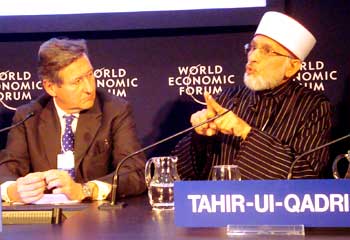
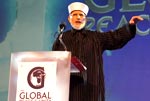
Dr Tahir-ul-Qadri speaking at World Economic Forum in Davos on 27 January 2011
(Also on the panel, on the right Mr John Chipman and on the left Mr Imran Khan)
Multi-pronged strategy needed to eliminate terrorism from world : Dr Muhammad Tahir-ul-Qadri
Dr Muhammad Tahir-ul-Qadri has said that terrorism has adversely impacted the economies of the developing and the developed countries. Terrorists have no religion. The phenomenon of terrorism has not appeared suddenly out of nowhere. Rather it has evolved through the phases of radicalism and extremism and terrorists are used as fodder for the cannons of the masterminds of this evil. He said that there are five phases through which terrorism passes. Radical and conservative attitudes are ideological in nature and give birth to militancy and terrorism.
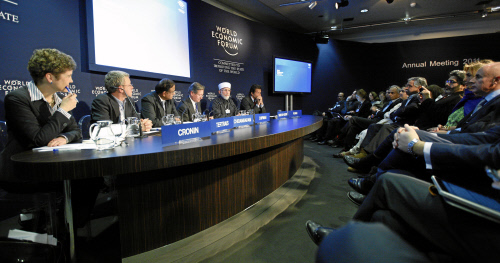
Panel discussing solution for terrorism at World Economic Forum (Mrs Audrey Kurth
Cronin, Mr Bruno Tertrais,
Mr Palaniappan Chidambaram, Mr John Chipman, Dr Tahir-ul-Qadri and Imran Khan)
According to the press statement issued by the Directorate of Media, Dr Muhammad Tahir-ul-Qadri expressed these views while addressing the annual meeting of the World Economic Forum in Davos. He is the only Islamic scholar from across the world who has been invited to speak at the World Economic Forum on ‘The Reality of Terrorism’. Dr Tahir-ul-Qadri said that terrorism has no religion and bracketing this anti-human practice with such peaceful religion as Islam is not correct. He further added that the handful of extremists who are the present-day custodian of the Kharjitte thought have nothing to do with Islam. “Those who cause havoc and mayhem through shedding of innocent blood are the criminals who deserved to be meted out exemplary punishment”, he said.
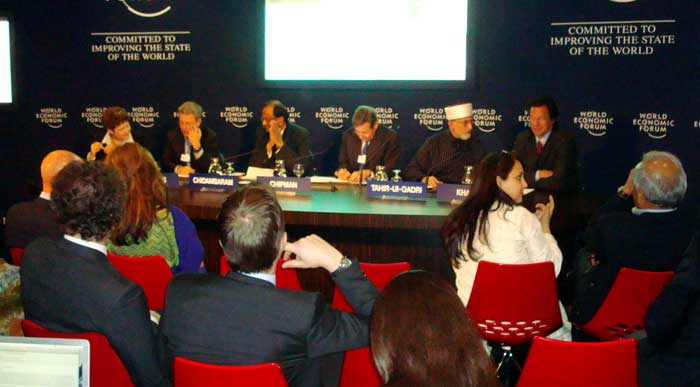
Panel discussing solution for terrorism at World Economic Forum (Mrs Audrey Kurth
Cronin, Mr Bruno Tertrais,
Mr Palaniappan Chidambaram, Mr John Chipman, Dr Tahir-ul-Qadri and Imran Khan)
He underlined the need of understanding the Islamic concept of Jihad in correct perspective. Jihad, he said, represents the culmination of efforts made for the establishment of peace and has five broad categories namely spiritual, intellectual, social, political, and defensive. Islam, he maintained, strictly forbids bringing any harm to unarmed people, women, and the old during the course of war. The actions of handful of bigoted elements cannot be dubbed as Jihad. He said that Islam does not recommend any Jihad, which allows people to do suicide bombings and slaughter innocent people.
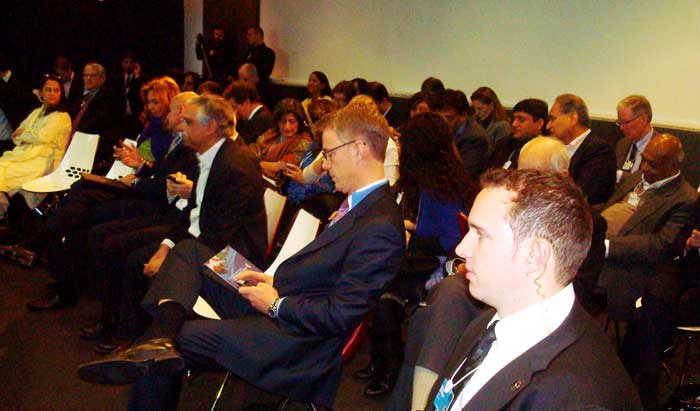
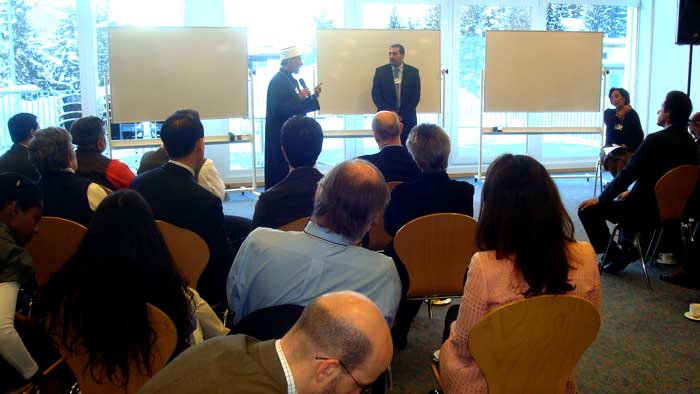
Audiance at the workshop "Religion's Role in Addressing Global Trends and Challenges"
Dr Tahir-ul-Qadri said that the root causes of terrorism need to be addressed if terrorism is to be eliminated comprehensively. He stressed the need of taking urgent steps for eradication of poverty from the developing world. He further said that the policy of associating terrorism with religions should be abandoned as no religion of the world including Islam approves of violence and the killing of humanity. He said that in order to bring the humanity closer, there is a need to launch interfaith dialogue among civilizations and build bridges. “This calls for highlighting commonalities,” he opined.Dr Tahir-ul-Qadri said that in order to effectively deal with counter-terrorism there is a need to promote social cohesion, multiculturalism and integration. He added that the model of isolation and assimilation should be avoided to promote social cohesion.

Dr Tahir-ul-Qadri speaking at World Economic Forum's workshop
"Religion's Role in Addressing Global Trends and Challenges"
He said that wrong terminology has been applied since 9/11. Therefore it is vital for the international community to de-link terrorism from Islam and to avoid terminology such as Islamist, jihadi, Islamic terrorist. He said terrorists have no religion and that they should be regarded as criminals only. He said that by using these terms the terrorist groups portray the war against terrorism as the war against Islam and this helps them to brainwash young people against the western world.
|
|
|
|
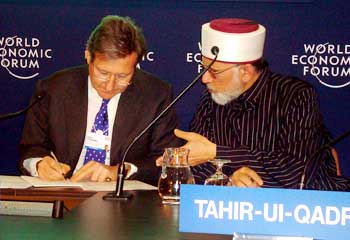
Dr Tahir-ul-Qadri and Dr John Chipman |
Dr Tahir-ul-Qadri and Imran Khan |

|
|
|
|
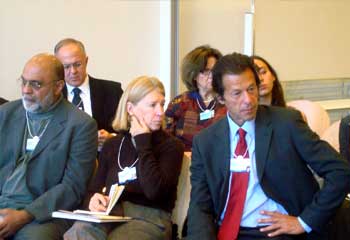
Imran Khan amongst the audience during the session "Religion's Role in Addressing Global Trends and Challenges" |
Dr Tahir-ul-Qadri presents solutions to tackle terrorism at the World Economic Forum |
Dr Muhammad Tahir-ul-Qadri spoke about the international situation and the increase of global terrorism after 9/11 and presented solutions on tackling the issue.Discussing the solutions, he explained that terrorist groups exploit the political situations of Palestine, Afghanistan, Iraq as well as Pakistan and India. Dr Qadri said that these international disputes and political situations must be resolved in order to tackle international terrorism effectively. He elaborated the importance of promoting educational programmes on peace and harmony in schools, colleges, universities and among the general public as well as among the clerics (Ulema). He said that programmes to enhance conflict resolution skills should be introduced in order to effectively resolve regional and national conflicts.
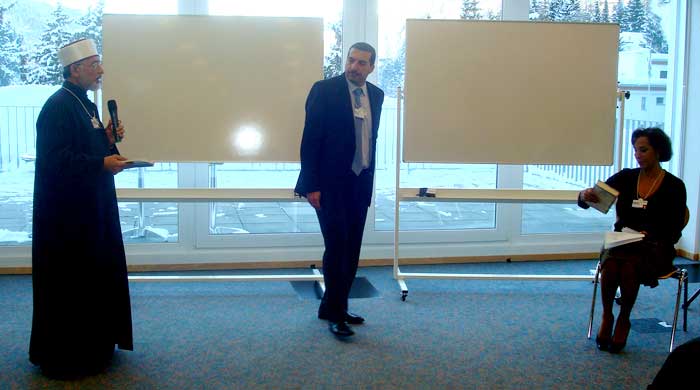
Dr Tahir-ul-Qadri speaking at the workshop "Religion's Role in Addressing Global
Trends and Challenges"
while Mr Amr Khaled listens
Mr John Chipman, Director-General and Chief Executive, International Institute for Strategic Studies (IISS) introduced Dr Tahir-ul-Qadri’s historic fatwa on terrorism and asked about its impact at the global level and in the Arab world. Dr Tahir-ul-Qadri informed the participants about its importance and its international impact and explained that its most prominent feature is that it is unconditional - without any ifs and buts hence there is no room for exception for terrorist acts.
Amr Mohamed Helmi Khaled with Shaykh-ul-Islam
Other speakers at the panel included Mrs Audrey Kurth Cronin (FLTR), Professor of Strategy, US National War College, USA; Mr Bruno Tertrais, Senior Research Fellow, Fondation pour la RechercheStrategique (FRS), France; Global Agenda Council on Weapons of Mass Destruction; Mr Palaniappan Chidambaram, Minister of Home Affairs of India; Mr John Chipman, Director-General and Chief Executive, International Institute for Strategic Studies (IISS), United Kingdom.Imran Khan, chairman of Tehreek-i-Insaaf, also attended the meeting of the World Economic Forum.
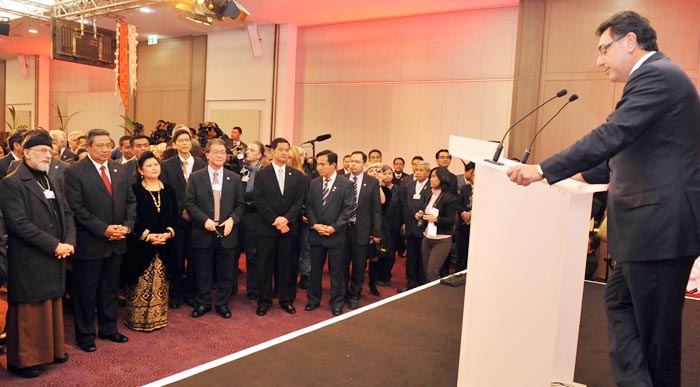
Dr Tahir-ul-Qadri standing with the President of Indonesia, Mr Susilo Bambang
Yudhoyono
at a reception during the World Economic Forum on 27 January 2011
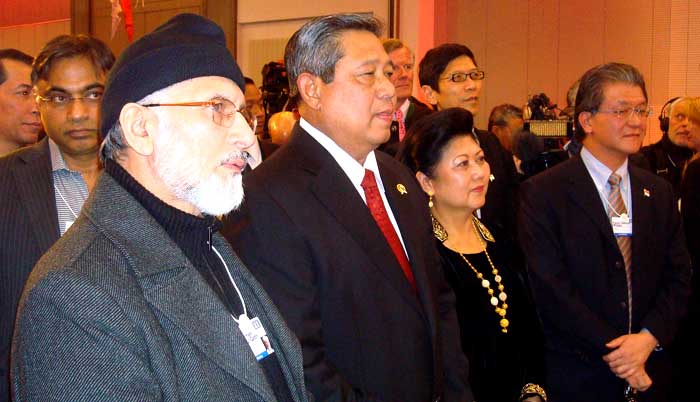
Shaykh-ul-Islam meeting with the President of Indonesia, Mr Susilo Bambang Yudhoyono
|
|
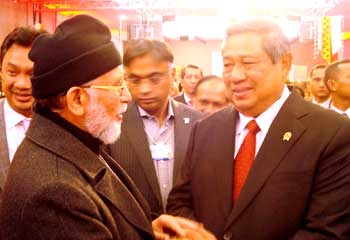
Dr Tahir-ul-Qadri meeting President of Indonesia, Mr Susilo Bambang Yudhoyono |
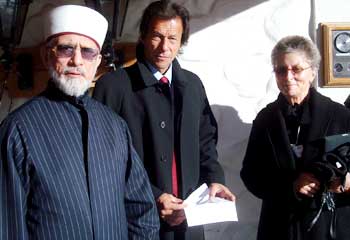
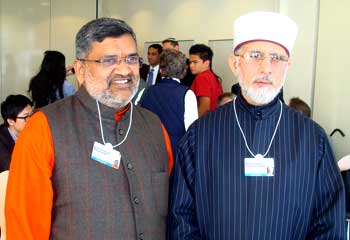
Dr Tahir-ul-Qadri, Imran Khan and a participant in Davos |
|
|
. |
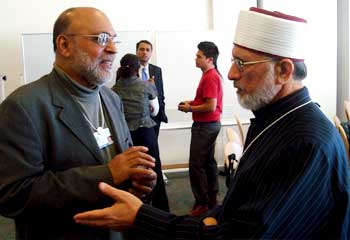
Fazlun Khalid with Dr Tahir-ul-Qadri |






Comments