
Analysing Muslims’ downfall (II)
This Article was published in
The Frontier Post (March 25, 2011)
http://www.pkarticleshub.com (March 25, 2011)
By Hussain Mohi-ud-Din Qadri
The facts presented in the last article show the Muslims at the pinnacle of their civilization glory and height of material progress. However, they have been going down the drain ever since and are now stuck in the worst ever downfall in their history. Three types of models were used in the past as far as religions are concerned, in an effort to create artificial oneness among them. These models are unification, simulation and integration.
The unification approach sought to bring religions together without understanding their inherent distinctions and characteristics. Different efforts premised at unification were made in the past to create reconciliation among religions but they could not bear positive outcomes. Mughal emperor Akbar, in 16th century India, tried to bring Muslims and Hindus together by contriving his own ‘Din-e-Elahi’ (Divine Religion), which he thought could be rendered into a state religion to establish a fundamental commonality among diverse peoples and a common identity. This was an unnatural way of integration, and ultimately a failure. Likewise, the example of simulation is best reflected in the philosophy of amalgamating ‘Ram’ (Hindu god) and ‘Raheem’ (Muslim God) espoused by the leaders of the Bakhti Movement, which could not succeed.
The basic reason behind the failure of these efforts was their unrealistic approach, which served to eliminate faith-based identity by imposing a uniform religion, foreign to all. Contrary to these, Islam has always supported and projected the idea of integration. Islamic faith acknowledges the distinctions and attributes of all religions. It enjoins upon its followers to accept and respect diversity. Integration approach presents a way out of our present-day challenges and lays the ground for sustained interfaith dialogue and harmony in the world. If these imperatives are fulfilled, peace can be restored to this otherwise blighted world. One dominant reason as to why the Muslim world has gone down so low in every walk of life such as politics, and economics etc. is the absence of unity in their ranks. Sectarianism has played havoc with the idea of unity. Theirs is a house smashed to the ground due to internal divisions and rifts. Sectarianism is also responsible for the status quo and presence of undemocratic orders.
All attempts at revolution and change within the Muslim Umma have failed due to sectarian affiliation and tendencies of those meant to spearhead the movement. Today the Muslim youths are highly disgruntled and disappointed with the way their countries are being run, afflicted with sectarian conflicts and turf-wars. Sectarianism has played a major role in alienating them. When they look for solutions, they are handed down prescriptions with prominent sectarian undertones. They fail to grasp the original Islam in a plethora of narrow-minded and sect-based versions of Islam, which are currently on offer. There is a need to rethink and review this state of affairs. We need to identify those responsible for making things so murky and confused. We must know that we are answerable to Allah Almighty and His Prophet (peace be upon him) for our deeds. We can allow this state of affairs to persist at our own peril. It is unfortunate that no serious efforts have been made to resolve the issue and if they have then they have been more of cosmetic measures, meant to push the entire matter under the carpet.
The models of unification and simulation failed miserably so far as the goal of achieving the sectarian harmony is concerned. I would recommend the integration approach to resolve this age-old riddle for good. Sects are a reality which cannot be wished away. If the unity within the broad stream of the Muslim Umma is our ultimate objective, then we need to start by acknowledging and accepting the differences that exist amongst various sects instead of making them a matter of life and death. The acceptance of diversity must pave way for emphasis on commonalities and shared values. The mosques and other religious institutions should not be used for fanning the fires of differences among the sects. The intellectual discussions which often become the cause of sectarian fights and havoc in society, must be held behind closed doors.
The tendency to make these differences public must be shunned. In order to comprehensively deal with the sectarian issue, there is a need to bring about fundamental changes in the educational system. It also calls for sweeping reforms in the structure and syllabi of religious seminaries or Madaris. The present syllabi being taught at various seminaries tend to promote sectarian interests. It is highly narrow-minded and produces a generation of conservative Mullahs who have myopic vision and are strongly attached to their sects and regard them as Islam. According to a study undertaken by Pakistan Education Statistics 2005-2006, the total number of seminaries belonging to different sects is 12,153 and the present enrolment of these institutions is 1,512,445. Such overwhelming number of students gets a daily dose of sectarianism and narrow interpretations of the texts of the Quran and has no exposure to the outside world.
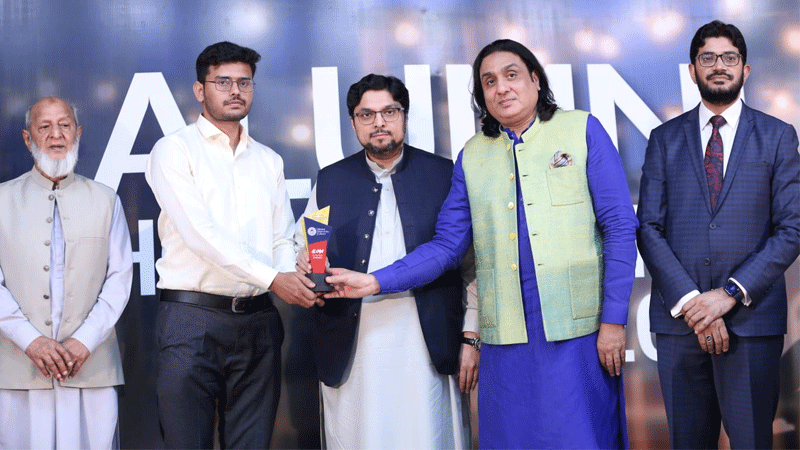
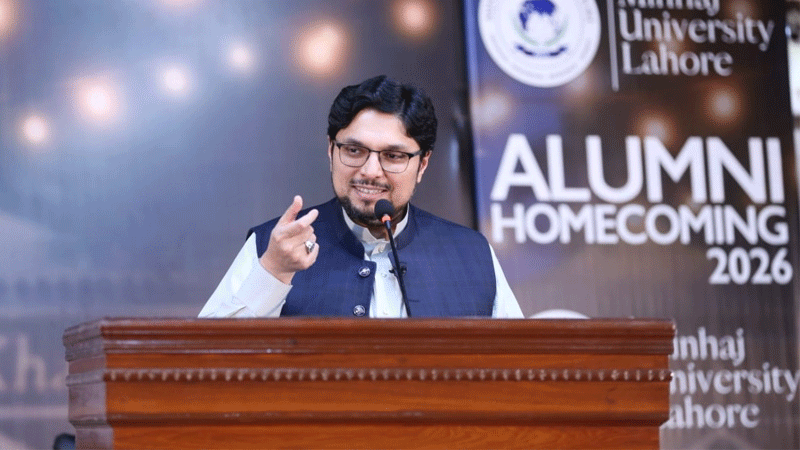
Once they pass out of these seminaries, they become a pawn in the hands of their sectarian handlers. I have a firm conviction that our raging problems having religious background cannot be resolved unless we bring about fundamental reforms in the syllabi of our Madaris. They need to be opened up to the outside world and amalgamated into the mainstream. This is possible if a uniform religious education up to a certain level is prescribed for every category of students. The coupling of religious and secular sciences at our educational institutions and universities of all hues and colour presents the best solution in the given circumstances. Minhaj University is a classic case in this regard where religious subjects are imparted along with the modern education. The scholars of this great seat of learning are playing their due role in propagating the real message of Islam and promoting peace, harmony and love in the world. I also have a request to make to the parents. They must educate and train their children for the sake of Islam instead of making them the prop of their old age.
Our great religion, Islam, is and must be over and above everything else. The mothers have also equally an important role to play in educating their children. We need people who are experts of religion on the one hand and experts of modern sciences on the other. Today we need our educational system to be structured on these lines and geared to achieve this objective. This is no doubt a daunting challenge. We can accomplish this if we make our intentions pious and are determined to achieve our objectives come what may. Let us resolve to work towards this end. (Concluded)






Comments