
Is an Industrial Emergency Inevitable in Pakistan? | Prof. Dr. Hussain Mohi-ud-Din Qadri Calls for Urgent Economic Reforms
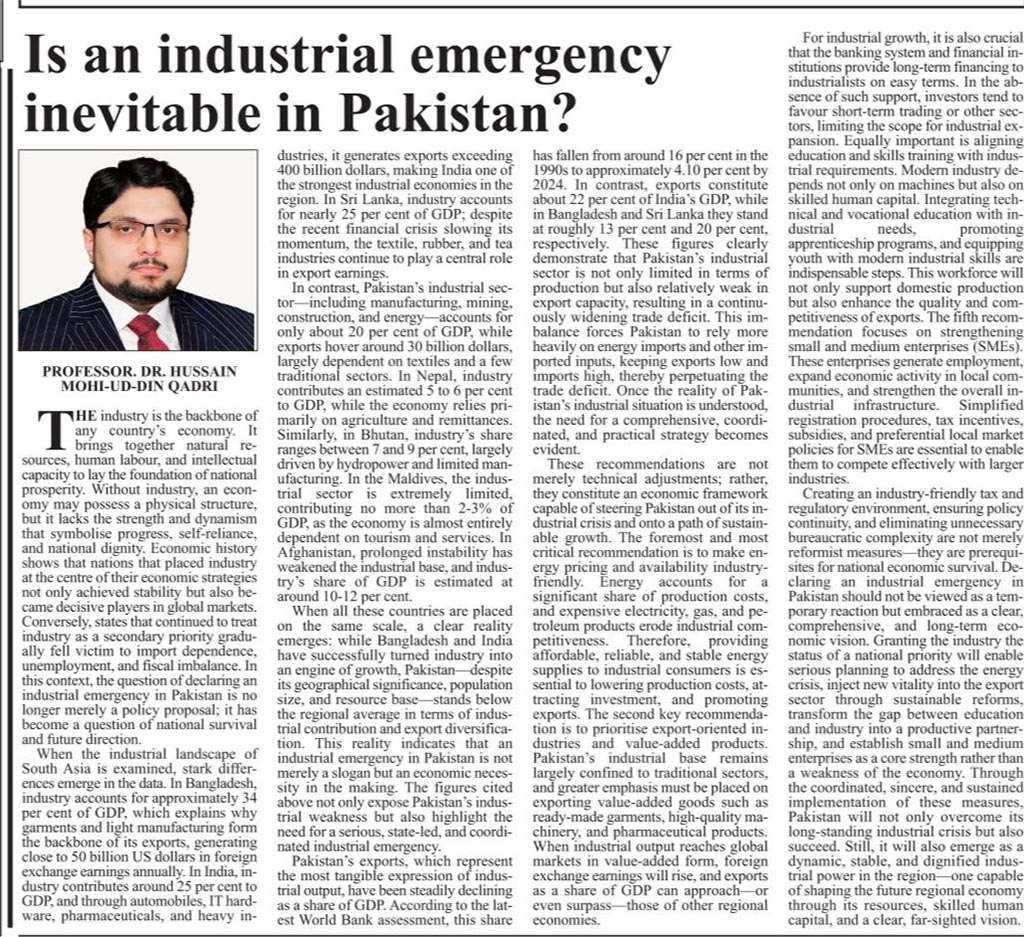
By: Professor Dr. Hussain Mohi-ud-Din Qadri (Economist)
The industry is the backbone of any country's economy. It brings together natural resources, human labour, and intellectual capacity to lay the foundation of national prosperity. Without industry, an economy may possess a physical structure, but it lacks the strength and dynamism that symbolise progress, self-reliance, and national dignity. Economic history shows that nations that placed industry at the centre of their economic strategies not only achieved stability but also became decisive players in global markets. Conversely, states that continued to treat industry as a secondary priority gradually fell victim to import dependence, unemployment, and fiscal imbalance. In this context, the question of declaring an industrial emergency in Pakistan is no longer merely a policy proposal; it has become a question of national survival and future direction.
When the industrial landscape of South Asia is examined, stark differences emerge in the data. In Bangladesh, industry accounts for approximately 34 per cent of GDP, which explains why garments and light manufacturing form the backbone of its exports, generating close to 50 billion US dollars in foreign exchange earnings annually. In India, industry contributes around 25 per cent to GDP, and through automobiles, IT hardware, pharmaceuticals, and heavy industries, it generates exports exceeding 400 billion dollars, making India one of the strongest industrial economies in the region. In Sri Lanka, industry accounts for nearly 25 per cent of GDP; despite the recent financial crisis slowing its momentum, the textile, rubber, and tea industries continue to play a central role in export earnings.
In contrast, Pakistan's industrial sector—including manufacturing, mining, construction, and energy—accounts for only about 20 per cent of GDP, while exports hover around 30 billion dollars, largely dependent on textiles and a few traditional sectors. In Nepal, industry contributes an estimated 5 to 6 per cent to GDP, while the economy relies primarily on agriculture and remittances. Similarly, in Bhutan, industry's share ranges between 7 and 9 per cent, largely driven by hydropower and limited manufacturing. In the Maldives, the industrial sector is extremely limited, contributing no more than 2-3% of GDP, as the economy is almost entirely dependent on tourism and services. In Afghanistan, prolonged instability has weakened the industrial base, and industry's share of GDP is estimated at around 10-12 per cent.
When all these countries are placed on the same scale, a clear reality emerges: while Bangladesh and India have successfully turned industry into an engine of growth, Pakistan—despite its geographical significance, population size, and resource base—stands below the regional average in terms of industrial contribution and export diversification. This reality indicates that an industrial emergency in Pakistan is not merely a slogan but an economic necessity in the making. The figures cited above not only expose Pakistan's industrial weakness but also highlight the need for a serious, state-led, and coordinated industrial emergency.
Pakistan's exports, which represent the most tangible expression of industrial output, have been steadily declining as a share of GDP. According to the latest World Bank assessment, this share has fallen from around 16 per cent in the 1990s to approximately 4.10 per cent by 2024. In contrast, exports constitute about 22 per cent of India's GDP, while in Bangladesh and Sri Lanka they stand at roughly 13 per cent and 20 per cent, respectively. These figures clearly demonstrate that Pakistan's industrial sector is not only limited in terms of production but also relatively weak in export capacity, resulting in a continuously widening trade deficit. This imbalance forces Pakistan to rely more heavily on energy imports and other imported inputs, keeping exports low and imports high, thereby perpetuating the trade deficit.
Once the reality of Pakistan's industrial situation is understood, the need for a comprehensive, coordinated, and practical strategy becomes evident. These recommendations are not merely technical adjustments; rather, they constitute an economic framework capable of steering Pakistan out of its industrial crisis and onto a path of sustainable growth. The foremost and most critical recommendation is to make energy pricing and availability industry-friendly. Energy accounts for a significant share of production costs, and expensive electricity, gas, and petroleum products erode industrial competitiveness. Therefore, providing affordable, reliable, and stable energy supplies to industrial consumers is essential to lowering production costs, attracting investment, and promoting exports.
The second key recommendation is to prioritise export-oriented industries and value-added products. Pakistan's industrial base remains largely confined to traditional sectors, and greater emphasis must be placed on exporting value-added goods such as ready-made garments, high-quality machinery, and pharmaceutical products. When industrial output reaches global markets in value-added form, foreign exchange earnings will rise, and exports as a share of GDP can approach—or even surpass—those of other regional economies.
For industrial growth, it is also crucial that the banking system and financial institutions provide long-term financing to industrialists on easy terms. In the absence of such support, investors tend to favour short-term trading or other sectors, limiting the scope for industrial expansion. Equally important is aligning education and skills training with industrial requirements. Modern industry depends not only on machines but also on skilled human capital. Integrating technical and vocational education with industrial needs, promoting apprenticeship programs, and equipping youth with modern industrial skills are indispensable steps. This workforce will not only support domestic production but also enhance the quality and competitiveness of exports.
The fifth recommendation focuses on strengthening small and medium enterprises (SMEs). These enterprises generate employment, expand economic activity in local communities, and strengthen the overall industrial infrastructure. Simplified registration procedures, tax incentives, subsidies, and preferential local market policies for SMEs are essential to enable them to compete effectively with larger industries.
Creating an industry-friendly tax and regulatory environment, ensuring policy continuity, and eliminating unnecessary bureaucratic complexity are not merely reformist measures—they are prerequisites for national economic survival. Declaring an industrial emergency in Pakistan should not be viewed as a temporary reaction but embraced as a clear, comprehensive, and long-term economic vision. Granting the industry the status of a national priority will enable serious planning to address the energy crisis, inject new vitality into the export sector through sustainable reforms, transform the gap between education and industry into a productive partnership, and establish small and medium enterprises as a core strength rather than a weakness of the economy.
Through the coordinated, sincere, and sustained implementation of these measures, Pakistan will not only overcome its long-standing industrial crisis but also succeed. Still, it will also emerge as a dynamic, stable, and dignified industrial power in the region—one capable of shaping the future regional economy through its resources, skilled human capital, and a clear, far-sighted vision.









Comments