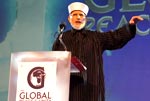
Minhaj-ul-Quran, a organisation based on Sufi principles which advises the Government on how to combat radicalisation in Muslim youth, launched its 600-page religious verdict in Central London this morning, condemning the perpetrators of terrorist explosions and suicide bombings.
Suicide bombers were described today as the "heroes of hellfire" by a leading Muslim scholar in a fatwa condemning terrorists as the enemies of Islam. Pakistan-born Dr Muhammad Tahir-ul-Qadri said there were no "ifs or buts" about terrorism and such acts had no justification in the name of Islam.
An influential Muslim scholar has issued a global ruling against terrorism and suicide bombing. Dr Tahir ul-Qadri, from Pakistan, says his 600-page judgement, known as a fatwa, completely dismantles al-Qaeda’s violent ideology. The scholar describes al-Qaeda as an “old evil with a new name” that has not been sufficiently challenged. Dr Qadri’s organization, Minhaj ul-Quran, is growing in Britain and has attracted the interest of policymakers and security chiefs. Marco Werman talks with The World’s religion editor Jane Little about the fatwa.
The leader of a global Muslim movement has issued a fatwa, or religious edict, that he calls an absolute condemnation of terrorism. Muhammad Tahir-ul-Qadri, a former Pakistani lawmaker, says the 600-page fatwa bans suicide bombing "without any excuses, any pretexts, or exceptions."
Dr Tahir ul-Qadri, from Pakistan, says his 600-page judgement, known as a fatwa, completely dismantles al-Qaeda's violent ideology. The scholar describes al-Qaeda as an "old evil with a new name" which has not been sufficiently challenged.
Muhammad Tahir ul-Qadri adalah tokoh Islam yang telah mempromosikan perdamaian dan dialog antar-agama selama 30 tahun. Dia mengatakan, terpaksa mengeluarkan fatwa ini karena kekhawatiran tentang radikalisasi Muslim Inggris di kampus-kampus dan karena kurangnya kutukan ulama dan cendekiawan muslim terhadap ekstremisme.
A Muslim leader in the UK has announced a special religious ruling, otherwise known as a fatwa, against terrorism in the name of Islam. The widely respected authority on Islamic law, Dr Tahir Qadri, has issued the fatwa, which condemns terrorism and suicide bombing.
The leader of a worldwide Muslim movement with thousands of followers in the UK is due to issue a fatwa - or Islamic religious ruling - condemning terrorism and warning suicide bombers that they are "destined for hell".
A leading Muslim scholar in Britain issued a fatwa Tuesday condemning terrorists and suicide bombers, saying they had no justification in the name of Islam. Pakistan-born Dr. Tahir ul-Qadri said there were no "ifs or buts" about terrorism, in a news conference attended by officers from London's Metropolitan Police, lawmakers, charitable organisations and think-tanks.
THE leader of a global Muslim movement has issued a fatwa, or religious edict, that he calls an absolute condemnation of terrorism. Muhammad Tahir-ul-Qadri, a former Pakistani lawmaker, says the 600-page fatwa bans suicide bombing 'without any excuses, any pretexts, or exceptions.'
The fatwa from Muhammad Tahir ul-Qadri, a leading figure who has promoted peace and interfaith dialogue for 30 years, echoes edicts condemning extremism issued by a number of Islamic groups since the Sept 11 attacks on the United States.
Muhammad Tahir-ul-Qadri, a former Pakistani lawmaker, says the 600-page fatwa bans suicide bombing "without any excuses, any pretexts, or exceptions." Tahir-ul-Qadri has issued similar, shorter decrees, but Tuesday's event in London was publicized by the Quilliam Foundation, a government-funded anti-extremism think tank and drew strong media attention.
Shaykh Dr Tahir ul-Qadri is a scholar of repute who has following across the East and the West. He is a Muslim scholar who had the likes of the al- Azhar institution of Cairo advocating his scholarship and knowledge. Al-Azhar in fact is seeking for the first time to have a college in Pakistan under Qadri’s auspices.
Muhammad Tahir ul Qadri is a leading figure who has promoted peace and interfaith dialogue for 30 years. He said he felt compelled to issue the fatwa because of concerns about the radicalisation of British Muslims at university campuses and because there had been a lack of condemnation of extremism by Muslim clerics and scholars.
De islam verbiedt zelfmoordaanslagen en bloedbaden met onschuldige burgers, luidt het in de fatwa van al-Qadri, de stichter van de wereldwijde Minhaj-ul-Quran-beweging. "De daders tonen aan dat ze ongehoorzaam zijn tegenover de islam, met andere woorden: ze zijn ongelovigen". In de 600 bladzijden tellende fatwa wil de schriftgeleerde theologische argumenten aan jonge islamieten leveren, die de retoriek van al-Qaida aanhangen.
The word 'fatwa' became synonymous with death threats in the 1980s after the publication of Salman Rushdie’s book The Satanic Verses prompted a fatwa that forced him into hiding for several years. But the religious ruling read out in London on Tuesday proves that this – incorrect - interpretation couldn’t be further from the truth.
A leading Islamic scholar has issued a fatwa in Britain condemning "terrorists" as the enemies of Islam, in a bid to deter young Muslims from extremism. Muhammad Tahir ul-Qadri, head of the Minhaj ul-Quran religious and educational organisation, said suicide bombers were destined for hell as he released his 600-page edict in London on Tuesday.
Muhammad Tahir ul Qadri is a leading figure who has promoted peace and interfaith dialogue for 30 years, Sky News reports. He said he felt compelled to issue the fatwa because of concerns about the radicalisation of British Muslims at university campuses and because there had been a lack of condemnation of extremism by Muslim clerics and scholars.
Dr Muhammad Tahirul Qadri, the founder of formidable Minhajul Quran movement, used a lecture in London to unreservedly condemn terrorist attacks and suicide bombers and urged the Muslim world to take a firm stand against those who bring Islam in disrepute.
4M
Facebook
2M
Twitter
© 1994 - 2026 Minhaj-ul-Quran International.