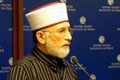
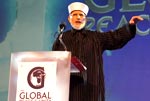
Muhammad Tahir-ul-Qadri says the 600-page fatwa bans suicide bombing "without any excuses, any pretexts, or exceptions." He is the founder of Minhaj-ul-Qur'an, a worldwide movement that promotes a non-political, tolerant Islam.
Muhammad Tahir-ul-Qadri, a former Pakistani lawmaker, says the 600-page fatwa bans suicide bombing "without any excuses, any pretexts, or exceptions." Tahir-ul-Qadri has issued similar, shorter decrees, but Tuesday's event in London was publicized by the Quilliam Foundation, a government-funded anti-extremism think tank and drew strong media attention.
Muhammad Tahir-ul-Qadri, founder of Minhaj-ul-Quran movement Tuesday issued an Islamic edict condemning terrorism and suicide bombings and challenged “al—Qaeda’s violent ideology.” Pakistan born Muslim scholar with a large following in Britain made his formal proclamation of a fatwa, or religious edict, at a news conference in London.
The leader of a global Muslim movement has issued a fatwa, or religious edict, that he calls an absolute condemnation of terrorism. Muhammad Tahir-ul-Qadri, a former Pakistani lawmaker, says the 600-page fatwa bans suicide bombing "without any excuses, any pretexts, or exceptions."
It never was and may never be easy to report about fatwas for a world audience. This point was driven home once again today when a prominent Islamic scholar presented to the media his new 600-page fatwa against terrorism and suicide bombing. Muhammad Tahir ul-Qadri is a Pakistani-born Sufi scholar whose youth workshops fostering moderation and understanding in Britain had already caught our attention. His effort to knock down any and every argument in favour of violence is certainly welcome. But the back story to this event is so complicated that it’s hard to report on the fatwa without simply ignoring many important parts of this back story.
London - An influential Muslim scholar with a large following in Britain Tuesday issued a fatwa - or Islamic religious ruling - which condemned global terrorism and branded suicide bombers as the "heroes of hellfire."The proclamation by Pakistan-born Muhammad Tahir-ul-Qadri, the founder of the global Minhaj-ul-Quran movement, was immediately welcomed by government leaders and followed closely by security organizations, parliamentarians and Muslim groups.
Muhammad Tahir-ul-Qadri, a former Pakistani lawmaker, says the 600-page fatwa bans suicide bombing "without any excuses, any pretexts, or exceptions." Tahir-ul-Qadri has issued similar, shorter decrees, but Tuesday's event in London is being hosted by the Quilliam Foundation, a government-funded, anti-extremism think tank.
Muhammad Tahir-ul-Qadri, a former Pakistani lawmaker, says the 600-page fatwa bans suicide bombing “'without any excuses, any pretexts, or exceptions.” Tahir-ul-Qadri has issued similar, shorter decrees, but Tuesday's event in London is being hosted by the Quilliam Foundation, a government-funded, anti-extremism think tank.
The comments were made during a remarkable assault on the ideology of violent Islamist extremists by Pakistani-born Sheikh Tahir ul-Qadri, a prominent theologian who launched a seminal fatwa in London yesterday condemning terrorism in all its forms.
Muhammad Tahir ul Qadri is a leading figure who has promoted peace and interfaith dialogue for 30 years. He said he felt compelled to issue the fatwa because of concerns about the radicalisation of British Muslims at university campuses and because there had been a lack of condemnation of extremism by Muslim clerics and scholars.
Dr Tahir ul-Qadri, from Pakistan, says his 600-page judgement, known as a fatwa, completely dismantles al-Qaeda’s violent ideology. The scholar describes al-Qaeda as an “old evil with a new name” which has not been sufficiently challenged.
Dr Tahir ul-Qadri, from Pakistan, says his 600-page judgement, known as a fatwa, completely dismantles al-Qaeda's violent ideology. The scholar describes al-Qaeda as an 'old evil with a new name' which has not been sufficiently challenged.
The leader of a worldwide Muslim movemen will today issue a fatwa – or Islamic religious ruling – condemning terrorism and warning suicide bombers that they are “destined for hell”. Pakistan-born Dr Muhammad Tahir-ul-Qadri, founder of the global Minhaj-ul-Quran movement, will make the formal UK proclamation of a fatwa, or religious edict, condemning terrorism and suicide bombing at a news conference in London.
The leader of a worldwide Muslim movement with thousands of followers in the UK is due to issue a fatwa - or Islamic religious ruling - condemning terrorism and warning suicide bombers that they are "destined for hell".
Suicide bombers have been described as the "heroes of hellfire" by a leading Muslim scholar in a fatwa condemning terrorists as the enemies of Islam. Pakistan-born Dr Muhammad Tahir-ul-Qadri said there were no "ifs or buts" about terrorism and such acts had no justification in the name of Islam.
4M
Facebook
2M
Twitter
© 1994 - 2026 Minhaj-ul-Quran International.