
The Importance of Moderation in the Islamic Economic System By: Prof. Dr. Hussain Mohi-ud-Din Qadri (Economist)
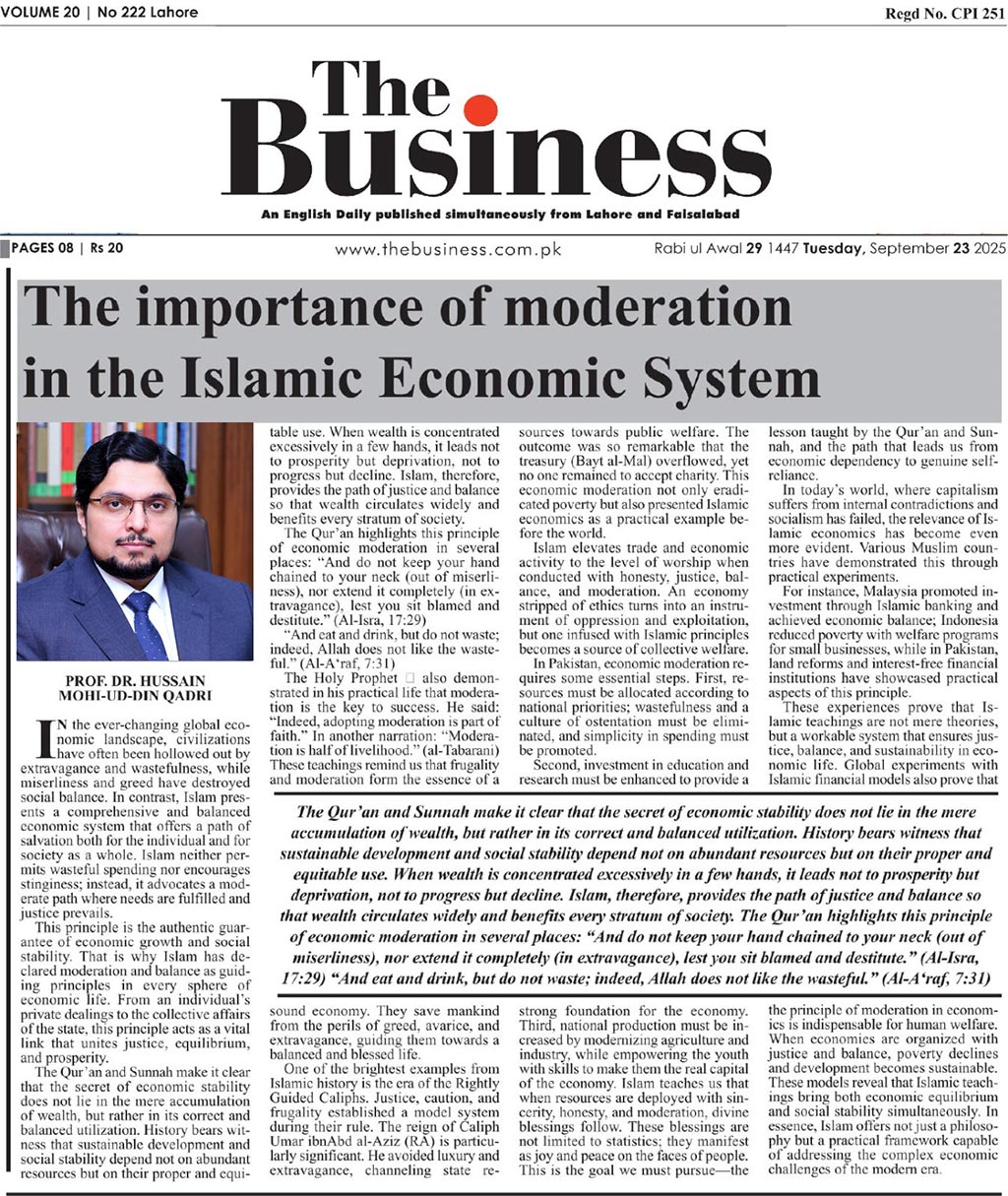
Prof. Dr. Hussain Mohi-ud-Din Qadri’s thought-provoking article on "The Importance of Moderation in the Islamic Economic System" published in The Business newspaper.
Highlighting Qur’anic principles of balance, justice, and sustainability, he explains how moderation ensures equitable growth, eliminates exploitation, and provides a practical alternative for global economic challenges.
In the ever-changing global economic landscape, civilizations have often been hollowed out by extravagance and wastefulness, while miserliness and greed have destroyed social balance. In contrast, Islam presents a comprehensive and balanced economic system that offers a path of salvation both for the individual and for society as a whole. Islam neither permits wasteful spending nor encourages stinginess; instead, it advocates a moderate path where needs are fulfilled and justice prevails. This principle is the authentic guarantee of economic growth and social stability. That is why Islam has declared moderation and balance as guiding principles in every sphere of economic life. From an individual’s private dealings to the collective affairs of the state, this principle acts as a vital link that unites justice, equilibrium, and prosperity.
The Qur’an and Sunnah make it clear that the secret of economic stability does not lie in the mere accumulation of wealth, but rather in its correct and balanced utilization. History bears witness that sustainable development and social stability depend not on abundant resources but on their proper and equitable use. When wealth is concentrated excessively in a few hands, it leads not to prosperity but deprivation, not to progress but decline. Islam, therefore, provides the path of justice and balance so that wealth circulates widely and benefits every stratum of society.
The Qur’an highlights this principle of economic moderation in several places
“And do not keep your hand chained to your neck (out of miserliness), nor extend it completely (in extravagance), lest you sit blamed and destitute.” (Al-Isra, 17:29)
“And eat and drink, but do not waste; indeed, Allah does not like the wasteful.” (Al-A‘raf, 7:31)
The Holy Prophet ﷺ also demonstrated in his practical life that moderation is the key to success. He said: “Indeed, adopting moderation is part of faith.” In another narration: “Moderation is half of livelihood.” (al-Tabarani) These teachings remind us that frugality and moderation form the essence of a sound economy. They save mankind from the perils of greed, avarice, and extravagance, guiding them towards a balanced and blessed life.
One of the brightest examples from Islamic history is the era of the Rightly Guided Caliphs. Justice, caution, and frugality established a model system during their rule. The reign of Caliph Umar ibn Abd al-Aziz (RA) is particularly significant. He avoided luxury and extravagance, channeling state resources towards public welfare. The outcome was so remarkable that the treasury (Bayt al-Mal) overflowed, yet no one remained to accept charity. This economic moderation not only eradicated poverty but also presented Islamic economics as a practical example before the world.
Islam elevates trade and economic activity to the level of worship when conducted with honesty, justice, balance, and moderation. An economy stripped of ethics turns into an instrument of oppression and exploitation, but one infused with Islamic principles becomes a source of collective welfare.
In Pakistan, economic moderation requires some essential steps. First, resources must be allocated according to national priorities; wastefulness and a culture of ostentation must be eliminated, and simplicity in spending must be promoted. Second, investment in education and research must be enhanced to provide a strong foundation for the economy. Third, national production must be increased by modernizing agriculture and industry, while empowering the youth with skills to make them the real capital of the economy. Islam teaches us that when resources are deployed with sincerity, honesty, and moderation, divine blessings follow. These blessings are not limited to statistics; they manifest as joy and peace on the faces of people. This is the goal we must pursue—the lesson taught by the Qur’an and Sunnah, and the path that leads us from economic dependency to genuine self-reliance.
In today’s world, where capitalism suffers from internal contradictions and socialism has failed, the relevance of Islamic economics has become even more evident. Various Muslim countries have demonstrated this through practical experiments. For instance, Malaysia promoted investment through Islamic banking and achieved economic balance; Indonesia reduced poverty with welfare programs for small businesses, while in Pakistan, land reforms and interest-free financial institutions have showcased practical aspects of this principle. These experiences prove that Islamic teachings are not mere theories, but a workable system that ensures justice, balance, and sustainability in economic life.
Global experiments with Islamic financial models also prove that the principle of moderation in economics is indispensable for human welfare. When economies are organized with justice and balance, poverty declines and development becomes sustainable. These models reveal that Islamic teachings bring both economic equilibrium and social stability simultaneously. In essence, Islam offers not just a philosophy but a practical framework capable of addressing the complex economic challenges of the modern era.
References
Islamic Ethics of Trade by Prof. Dr. Hussain Mohi-ud-Din Qadri (Economist)
Islamic Microfinance: Landscape, Models and Future Prospects by Prof. Dr. Hussain Mohi-ud-Din Qadri (Economist)








Comments