
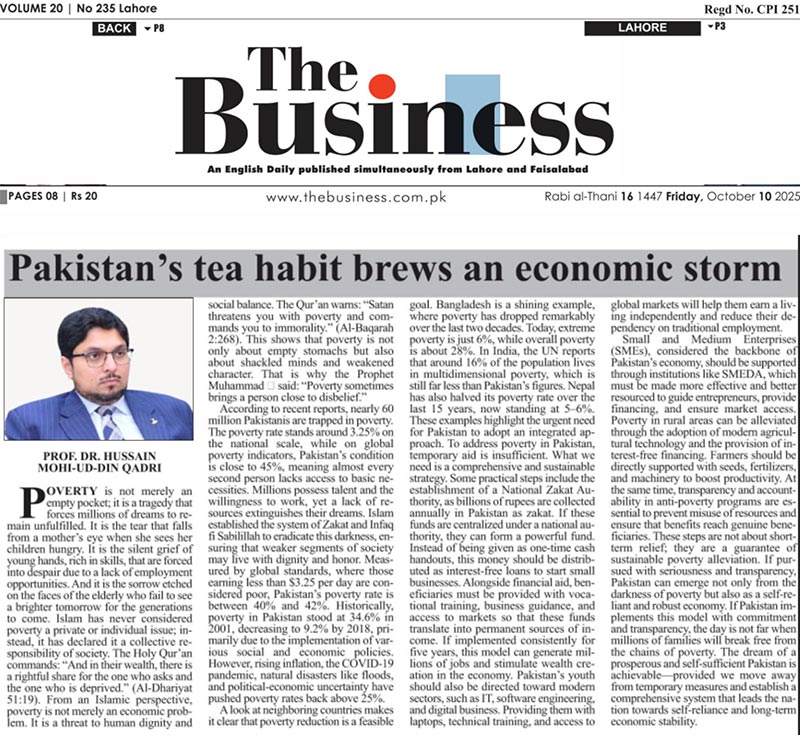
How Can Pakistan Be Lifted Out of Poverty? By Prof. Dr. Hussain Mohi-ud-Din Qadri (Economist)
overty is not merely an empty pocket; it is a tragedy that forces millions of dreams to remain unfulfilled. It is the tear that falls from a mother’s eye when she sees her children hungry. It is the silent grief of young hands, rich in skills, that are forced into despair due to a lack of employment opportunities. And it is the sorrow etched on the faces of the elderly who fail to see a brighter tomorrow for the generations to come. Islam has never considered poverty a private or individual issue; instead, it has declared it a collective responsibility of society. The Holy Qur’an commands: “And in their wealth, there is a rightful share for the one who asks and the one who is deprived.” (Al-Dhariyat 51:19). From an Islamic perspective, poverty is not merely an economic problem; it is a threat to human dignity and social balance. The Qur’an warns: “Satan threatens you with poverty and commands you to immorality.” (Al-Baqarah 2:268). This shows that poverty is not only about empty stomachs but also about shackled minds and weakened character. That is why the Prophet Muhammad ﷺ said: “Poverty sometimes brings a person close to disbelief.”
According to recent reports, nearly 60 million Pakistanis are trapped in poverty. The poverty rate stands around 3.25% on the national scale, while on global poverty indicators, Pakistan’s condition is close to 45%, meaning almost every second person lacks access to basic necessities. Millions possess talent and the willingness to work, yet a lack of resources extinguishes their dreams. Islam established the system of Zakat and Infaq fi Sabilillah to eradicate this darkness, ensuring that weaker segments of society may live with dignity and honor. Measured by global standards, where those earning less than $3.25 per day are considered poor, Pakistan’s poverty rate is between 40% and 42%. Historically, poverty in Pakistan stood at 34.6% in 2001, decreasing to 9.2% by 2018, primarily due to the implementation of various social and economic policies. However, rising inflation, the COVID-19 pandemic, natural disasters like floods, and political-economic uncertainty have pushed poverty rates back above 25%.
A look at neighboring countries makes it clear that poverty reduction is a feasible goal. Bangladesh is a shining example, where poverty has dropped remarkably over the last two decades. Today, extreme poverty is just 6%, while overall poverty is about 28%. In India, the UN reports that around 16% of the population lives in multidimensional poverty, which is still far less than Pakistan’s figures. Nepal has also halved its poverty rate over the last 15 years, now standing at 5–6%. These examples highlight the urgent need for Pakistan to adopt an integrated approach.
To address poverty in Pakistan, temporary aid is insufficient. What we need is a comprehensive and sustainable strategy. Some practical steps include the establishment of a National Zakat Authority, as billions of rupees are collected annually in Pakistan as zakat. If these funds are centralized under a national authority, they can form a powerful fund. Instead of being given as one-time cash handouts, this money should be distributed as interest-free loans to start small businesses. Alongside financial aid, beneficiaries must be provided with vocational training, business guidance, and access to markets so that these funds translate into permanent sources of income. If implemented consistently for five years, this model can generate millions of jobs and stimulate wealth creation in the economy. Pakistan’s youth should also be directed toward modern sectors such as IT, software engineering, and digital business. Providing them with laptops, technical training, and access to global markets will help them earn a living independently and reduce their dependency on traditional employment.
Small and Medium Enterprises (SMEs), considered the backbone of Pakistan’s economy, should be supported through institutions like SMEDA, which must be made more effective and better resourced to guide entrepreneurs, provide financing, and ensure market access. Poverty in rural areas can be alleviated through the adoption of modern agricultural technology and the provision of interest-free financing. Farmers should be directly supported with seeds, fertilizers, and machinery to boost productivity. At the same time, transparency and accountability in anti-poverty programs are essential to prevent misuse of resources and ensure that benefits reach genuine beneficiaries.
These steps are not about short-term relief; they are a guarantee of sustainable poverty alleviation. If pursued with seriousness and transparency, Pakistan can emerge not only from the darkness of poverty but also as a self-reliant and robust economy. If Pakistan implements this model with commitment and transparency, the day is not far when millions of families will break free from the chains of poverty. The dream of a prosperous and self-sufficient Pakistan is achievable—provided we move away from temporary measures and establish a comprehensive system that leads the nation toward self-reliance and long-term economic stability.
References:
Islamic Microfinance – Prof. Dr. Hussain Mohi-ud-Din Qadri
Islamic Ethics and Trade – Prof. Dr. Hussain Mohi-ud-Din Qadri








Comments