It was so good to see this time that CNN covered the event: Last week, a prominent Muslim cleric, Muhammad Tahir ul-Qadri, issued a fatwa, or religious edict, against terrorism in general, and suicide terrorism in particular. Although edicts such as these have been issued in the past, this particular fatwa is important in that the scholar who authorised it is the founder of the Minhaj-ul-Quran International movement, with centers in 90 countries.
Muhammad Tahir ul-Qadri, head of the Minhaj ul-Quran religious and educational organization, said suicide bombers were destined for hell as he released his 600-page edict in London on Tuesday. He is a Pakistani born well read and written Islamic scholar. He will have great influence, I am psyched!
One of the influential Muslim "scholars" in Britain has issued a fatwa banning terror attacks and bombings, insisting that there is no justification for terror acts in the name of Islam. At a press conference attended by the London officials, police, lawmakers and leaders of organizations, Muhammad Tahir al-Qadri said that the acts cause one to be out of his faith (Islam- ed.)
Sometime in the past week the leading scholar Dr. Tahir-ul-Qadiri issued a Fatwa against suicide bombing. I have not read it through yet, but from what I have read and the reports are that the 600 page document takes apart all religious justifications and rationalizations for terrorist activities. In fact, from what I have read it declares that not only are these acts illegal in Islam but that those who perpetrate them are no longer Muslims and after performing their heinous act will go to hell.
We, in the non-Muslim west, have grown used to hearing of fatwas, usually characterized as calls for terror and violence and issued under questionable authority. By no means anyone or everyone has the authority to issue a fatwa. It requires legitimate institutional authority; the one issuing the fatwa has to be a scholar of renown and beyond dispute.
It was so good to see this time that CNN covered the event: Last week, a prominent Muslim cleric, Muhammad Tahir ul-Qadri, issued a fatwa, or religious edict, against terrorism in general, and suicide terrorism in particular. Although edicts such as these have been issued in the past, this particular fatwa is important in that the scholar who authoried it is the founder of the Minhaj-ul-Quran International movement, with centers in 90 countries.
A leading Islamic scholar has issued a fatwa in Britain condemning "terrorists" as the enemies of Islam, in a bid to deter young Muslims from extremism. Muhammad Tahir ul-Qadri, head of the Minhaj ul-Quran religious and educational organisation, said suicide bombers were destined for hell as he released his 600-page edict in London on Tuesday.
FOUNDER and patron-in-chief of Tehrik Minhajul Quran Dr Tahirul Qadri has termed suicide attacks and bomb blasts in a Muslim country as anti-Islamic, since the religion strictly prohibited taking lives of innocent citizens.
LONDON (AP) -- The leader of a global Muslim movement has issued a fatwa, or religious edict, that he calls an absolute condemnation of terrorism. Muhammad Tahir-ul-Qadri, a former Pakistani lawmaker, says the 600-page fatwa bans suicide bombing ''without any excuses, any pretexts, or exceptions.''
The media has somehow overlooked a development of immense importance. The 600-page Fatwa (edict) issued by renowned Islamic scholar Dr Tahir-ul-Qadri against terrorism is worth reading. The learned scholar has categorically proved in his testimony, in the light of Holy Quran and teachings of Prophet Muhammad (peace be upon him), that Islam forbids the killing of innocent citizens and suicide bombings.
Einiges Aufsehen hat in westlichen Medien vergangene Woche eine neue Fatwa gegen Selbstmordattentäter und Terrorismus erregt. Endlich, so scheint es, gibt es eine klare Distanzierung des gemäßigten Islam vom Radikalismus. Das islamische Rechtsgutachten des pakistanischen Gelehrten Tahir ul Qadri ist zwar nicht die erste Fatwa in diesem Sinne,
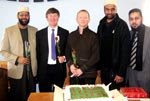
It was a lovely Sunday morning, the sky clear blue, the sun shining and it’s the month of ‘Rabi’al-Awwal - the first spring’ in which the birth of the Beloved Prophet Muhammad (blessings and peace be upon him) took place. In celebrating this blessed occasion, Farghana Institute (FI) was invited by the ‘Trinity Community Church’ (TCC) to participate in ‘Peace in the Mix – celebrating Peace Week 2010’ at the Amani Centre, Manchester.
The armed takeover of the Grand Mosque in Mecca in 1979 was a pivotal point in modern extremism. Led by the former Saudi national guardsman Juhayman al Utaibi and the false Mahdi Mohammed al Qahtani, the two-week occupation violated the most basic principles of Islam. While spilling the blood of fellow Muslims in Islam’s holiest site, the rebels continued to claim divine justification for their acts. It was only after he was caught that al Utaibi admitted he had been wrong.
The leading scholar Dr Tahir ul Qadri explains today why he issued a fatwa condemning terrorism and declaring suicide bombers to be un-Islamic. Writing exclusively for The Nation al, Dr ul Qadri, the founding leader of the peace-promoting group Minhaj ul Quran, said: “Terrorism cannot be justi ed in any way.”
I have been compelled to issue a fatwa – a comprehensive theological refutation of Islamist terrorism – because of what has been happening in Pakistan over the past year. Terrorists are bombing mosques during Friday prayers, they are burning schools, killing women. They are digging bodies out of graves, cutting off their heads and hanging the bodies from trees.
For the first time, a major international Muslim leader has issued an in-depth fatwa (holy edict) declaring that Islamic suicide bombers are evil, that they aren't rewarded with 72 virgin nymphs in heaven, and that they actually cease to be Muslims and go to hell.
4M
Facebook
2M
Twitter
© 1994 - 2026 Minhaj-ul-Quran International.